Showing posts with label support. Show all posts

Tuesday, January 12, 2016

Can't You Just

Some of the most significant conversations I've had were not positive. People I considered sources of support expressed their opinions about how I handled living with trauma, my trauma, and when I disagreed, the tone shifted. Their concern gave way to frustration. For me, nervousness turned into anxiety and feelings of isolation soared. I wanted them to tell me, "Whatever you need, we'll be here." Instead, I heard, "Why can't you just...?"

When facing a complex situation where there is no quick fix, opinions are abundant. People are more than willing to tell you exactly what you should do and when you dispute their unsolicited advice, their frustration speaks louder than their concern. They ask, "Why can’t you just…?" Just stop thinking about it. Just be quiet. Just go along to get along. Just stop expecting so much. Just let it go. Just get over it. Essentially, what they are asking you to do is to stop existing in a space or with an honesty that threatens their space and their delusion. Guess what. You don’t have to. You don’t have to 'just' do anything.

When someone asks or implies that you need to just do something that counters what is best for you, remove yourself. Remove yourself from the conversation, the physical space, from living under their expectations, and in some cases, from the relationship. You do not deserve to exist in an uncomfortable, non-supportive space. Create a new space. Build a new support system.

Your loved ones' decision to live in an unhealthy environment is not yours. The complacency that controls the lives of those you know does not have to control you. The fears that derail others do not have to derail you. If you ever have to choose between taking the road paved in denial, religious manipulation, and self-sacrifice so that others can feel more comfortable with the hurt that you live with and the unexplored, less crowded path toward wellness, always choose wellness. If you deserve to just do anything, you deserve to just choose your peace, safety, and freedom.

Tuesday, December 22, 2015

Space

We have been convinced that spaciousness is supreme. We dream of owning a huge house with as many bathrooms as bedrooms, a three-car garage, on land large enough to house a compound. In addition to our mega complex for more spacious things, personal space is also valued at such a premium that airlines and rail lines charge more money for it. Space is a hot commodity that has changed what we want and the way we live, travel, and interact with one another.

When I moved to Michigan in 2012, I moved into a large apartment, by myself. While it was often convenient and comfortable, I didn't need all of that space and having it did not always serve me well. It was great when I had overnight guests. It was not great when I felt alone. It seemed to amplify the loneliness and bounce it off of every wall for me to hear over and over again. That space also enabled me to keep things I should have released, purchase things I didn't need, and shut the door on all of those things so I didn't have to look at them or deal with them.

In addition to the drawbacks associated with physical space, there's another element of space that I subscribed to that was more detrimental—emotional space. Keeping emotional space, distance, did not always serve me well either. I developed emotional distance for the same reason that most do—because the actions of a few destroyed my ability to trust. When I did discover my support system, which was solid, genuine, and fully committed to my well-being, I was too embarrassed, ashamed, and flat out terrified to truly let people in to what I deemed my overwhelming, complicated emotional vault.

Being distant from others produced outcomes that contradicted what I wanted. Space gave my mind room to wander to horrible places, replaying scenes of my history of trauma. Space allowed me to get lost in the negative messages I repeated to myself. Space made me feel alone and undeserving of the support, acceptance, and love I needed. All of the emotional work I'd done to create a sense of safety and peace was evaporating in that space. Space was not what I needed. I needed connection. I needed people right there, up close and personal, not just telling me I had their support, but demonstrating it, repeatedly. I didn't need more space, I needed less. Much less.

When we have space, we have extra room for miscellaneous things—all the stuff that has no specific place and at times, no value. We put it in a spare room and shut the door so that we can maintain attachments that need to be severed without having to see the impact of those unhealthy attachments. We give ourselves so much space that it prevents others from getting close enough to witness our emotional clutter, making it impossible for them to help us clear it out.

Does space provide you with convenience and comfort or has it become an enabler? Have you given those you trust, those who have proven their commitment to your well-being, access to fully support you? Are you being honest with them? Are you being honest with yourself?

Assess the space in your life. Make necessary adjustments. All of the support you need will be there. Don't be afraid to let people in. Don't be afraid to get close. We were designed to be connected and have relationships. It is when those connections and bonds are broken that we feel disrupted, abandoned, and unloved. Space is not always the answer. At times, space is the problem.

Tuesday, December 8, 2015

Prove Them Wrong

Last week I attended a college basketball game. Early in the first half, a point guard from the visiting team attempted a long-range shot. In addition to it being highly contested, he miscalculated and the ball missed the entire rim. Fans of the home team immediately yelled, "Air ball! Air ball! Air ball!" For the remainder of the game, any time he touched the ball, no matter where he was on the court and whether he was in position to shoot or not, the crowd erupted in a chorus of, "Air ball! Air ball! Air ball!"

This collective attempt to distract players is normal in sports and can be extremely effective. Without proper coaching, focus, and confidence, a well guarded shot or simple miscalculation can impact a player's performance for the duration of a game. Experienced players master tuning out distractions, regardless of how noisy, relentless, and personal they become.

You may feel as if life is a lot like those fans. The shots you've taken may have been highly contested, miscalculated, or a combination of both, and each time you try again, life reminds you of your air ball moments. As soon as you build enough courage to go back out there, someone—at times, even you—is screaming what you perceive to be your worst moments and attributes. Quitter! Dropout! Unemployable! Divorced! Damaged! Victim! Abandoned! Convict! Angry! Depressed! Broken! Failure! Worthless! Unlovable!

How do you quiet the yelling? How can you make progress when you are continuously reminded of your worst? How do you stop the yelling when you believe it more than anyone else? You quiet the yelling with action. You make progress by focusing on one play, one task, one goal at a time. You stop believing the yelling by remaining engaged with and committed to improving your life, for life. 

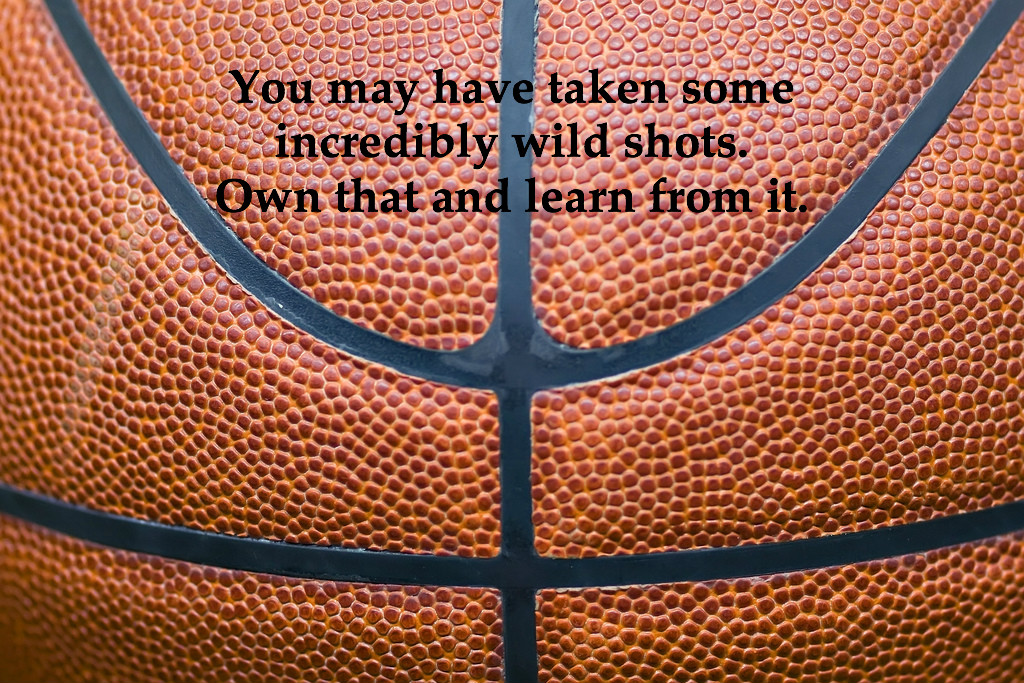
Your goals may have been contested. Try again. You may have taken some incredibly wild shots. Own that and learn from it. But never, ever, ever, ever give up. Unlike with a game, your refusal to show up will not stop the hate-filled, destructive mantras. When you no longer try, you concede and behave in ways that confirm the worst of what you think of yourself. Instead of confirming the taunts, prove them wrong.

As for that particular game, the player who threw that errant shot remained present and a valuable member of his team. By the end of the game he was the third leading scorer and more importantly, his team won. He didn't allow ridicule to stop him and you don't have to let life's ridicule and reminders to stop you. Get back out there and prove them wrong.

Tuesday, September 16, 2014

Your Purpose

The notion of purpose causes many of us distress and anxiety. We try to determine our purpose by collectively evaluating our natural abilities, interests, and those seemingly random events and connections that we classify as chance or fate. No matter how much we worry and will ourselves to come to a clear conclusion, our amateur analysis provides us with more questions than answers and can leave us frustrated and frozen with fear.

The short answer is that your purpose is to advance the life of others. How you do that is what you will have to discover so your question is not what is your purpose, but how you will reach it. You may be an educator, an artist, an inventor, a scientist, or a chef. You may be a community activist, a volunteer, or the first person in your family or neighborhood to graduate from college. You may raise your family in a loving home and be a positive role model to your children or other children in your life. You may provide food to those who are struggling, a home to children without one, or encouragement and support to those who feel broken. There is purpose in all of that.

Your purpose is found in the journey of discovering yourself. As you grow and gain life experiences, you develop the confidence to accept that you have purpose, the clarity to gravitate in the direction of what sustains you, and the strength to work—and it is work—that purpose out. You do not find fulfillment suddenly. Fulfillment of purpose does not announce itself in some magical moment with fireworks and blaring trumpets. You are fulfilled through the process of discovering who you are purposed to become; someone who fully lives and by example, promotes and encourages progression in others.


Tuesday, July 29, 2014

Distress

At the start of the summer season, there is an increase in news reports on water safety. One of the most important notices is about the behavior of those who are drowning. Most assume that there will be screams and violent splashing, but those in distress while swimming barely make a sound or much movement. Unfortunately, people struggle silently while others watch, unaware of the desperation occurring below the surface.

We are constantly immersed in life. We make decisions today that will influence our future while simultaneously doing the emotional hard work of reconciling our past. We are surrounded by people who teach us difficult lessons, show us ourselves, and make us demonstrate love instead of simply say it. We try to make the life we face better than what we've left behind while remaining grateful and mindful of the present. It is a constant balancing act that tests our stamina, stretches our faith, and repeatedly proves and disproves what we have been taught and believe.

While it is easy and even understandable to be engrossed in your life, consider how you can show your loved ones that you support and truly see them. Don't wait for screaming or splashing from your spouse, parents, siblings, and friends to extend your hand and reach out. Signs of sadness may not match your expectations. Distress may not be as visible or cause as much of a commotion as you anticipate. Do not let someone you love feel as if s/he is drowning right in front of you simply because it doesn't appear as you imagine.

Tuesday, July 8, 2014

Live Up

Hoi An, Vietnam
For more years than I care to admit, I handed the responsibility of my emotional health to others. I desperately wanted to believe that those who told me they loved me were looking out for my best interests. Sadly, my best interests clashed with what they wanted so the direction they were leading me contradicted where I needed to go. It wasn't until I grew strong enough and developed the confidence to trust my judgment that I took responsibility for my emotional health and began to live honestly.

I was one of those kids who hated to be yelled at and punishment was not my friend. I wanted to make the adults in my life happy and people-pleased to a fault. As I grew older, I was no longer at risk of getting into trouble, yet the self-sacrificing behavior continued. I realized it wasn't trouble that I had been avoiding all of those years, but disappointing others. In trying to live according to their expectations, I was holding myself back and failing to live up to the expectations I had for myself.

People tell me to settle down, have children, lower my guard, and relax my boundaries. They rationalize these directives using fear and guilt, but what they are really saying is, "Do what I did," or "Stop living your life in a way that I lacked the confidence to even consider." Instead of internalizing their fears and regrets, I've accepted that my life is not conventional because my heart's desires are not conventional. Instead of trying to fit into the notion of what others believe or want, I've learned to trust my instincts, live fully, and not apologize for it. Working through my fear of disappointing others and ultimately, losing their support has taught me two life-altering, freeing lessons:
  • it is much more detrimental to live a life that I find disappointing and
  • I will always have the support I need because those who honestly love me will always remain.
Not everyone will comprehend the course of your life. That does not necessarily mean that they wish to see you fail. Some are simply not capable of comprehending your future because it exists in a space that they cannot fathom. Your life choices are yours and you have to live with the consequences in a way that no one else will. Develop the strength and confidence to trust your judgment. When you live honestly, you usher in people who will support and love you honestly, and there is nothing fearful, nor disappointing in that.

Tuesday, May 20, 2014

The Golden Rule

You've heard the adage 'treat others the way you want to be treated' countless times. It's the Golden Rule and typically, it is great advice. It is both a normal expectation and an admirable quality to base your consideration of others on how you want to be considered. What happens, though, when how you want to be treated is not equal to how you deserve to be treated?

Relationships are one of the most important aspects of life. In your connections you find support, understanding, healing, love, and essentially, a reflection of yourself. Those who love you make the choice to be a part of your life and include you in theirs. It's a commitment. Even when the love is there, though, if you take that love or the people giving it for granted and ignore their needs and become distant, doubt begins speaking louder than trust. Your loved ones will question if they are in the relationship, or feeling a level of openness and safety all by themselves.

How you feel about yourself impacts how you treat those you love. If you don't think you're deserving of honesty, support, and care then your behavior will reflect that and you will sabotage your relationships and what you need. Rather than lean into your support, because you don't trust it and don't believe you deserve it, you pull back. Without realizing it, you treat your loved ones in the way you think you should be treated and in this instance, it's less than what all of you deserve.

In order to fully understand the sentiment behind treating others the way you would like to be treated you have to also understand how you should be treated. You may know that you don't deserve to be abused, lied to, cheated on, betrayed, or ignored because those are extremes. Those are easy to identify and reject. There are more subtle behaviors that you also don't deserve. You don't deserve to open up to someone and have him/her retreat. You don't deserve to consistently prove yourself trustworthy because of the actions of another. You don't deserve to have to face difficulty alone. You don't deserve to want an embrace and not feel vulnerable enough to ask for or accept one. You don't deserve to feel like you are in a relationship of any kind by yourself and neither does anyone you love.

Emotions can be scary. Depending on others to be there when you need them can be terrifying. Yet imagine how it feels for your significant other, parents, children, siblings, or close friends to have to deal with the normal fears of trusting and letting go combined with your refusal to trust them and let go. When you fully understand, appreciate, value, and love you then, and only then, can you truly understand, appreciate, value and love others.

Tuesday, December 10, 2013

Space to Walk

On a snowy day, I was walking to my apartment building. It was 25 degrees so I was in a hurry to get inside, but a man and what I assumed were his sons caught my eye. The father and oldest son walked on the shoveled sidewalk. Their path was easy and clear. The youngest son, while going in the same direction, took a different path at his own pace. This little guy choose to walk in the grass. He had to step up higher to get through so he was slightly behind. He ran at times as he kicked through the fluffy snow. It was as if there was no other place he would rather be than on his whimsical walk.

I have this incessant desire to be supportive. If those I love need a word of encouragement or a shoulder to cry on, I want to be "Johnny on the spot." At times, that's appropriate. There are other times, though, when people need space to sift through their feelings. They need to process and listen inwardly in order to develop. At those moments, as much as I want to be right there, I have to love them enough to let them walk in their own space. I have to put my needs—and really, my insecurities and fears—aside and allow them to walk on their own even when I would prefer to walk with them.

We walk through life with others, but even when we're together emotionally, we're not always supposed to be directly side-by-side. We have to give those we love the space to walk. It can be difficult because we fear separation or we want to provide up close and personal support. However, just as the father gave his little boy the joy of walking through the snow, we can give our loved ones the satisfaction of self-reliance just by providing a little bit of space.

Read last week's post, The Spirituality of Natural Gifts.

Tuesday, September 10, 2013

Power of a Selfie

Technology has altered how we connect, even down to our language. Just a few years ago the word selfie would have conjured up confusion, but now it's a fairly common term. There are countless pictures on social media sites of self-portrait photos and they have an added entertainment value because many of them unintentionally capture something humorous in the background. When the subject of a picture is also the one performing the action of taking the picture, the focus is not on the background. In a selfie, the full setting appears in the end product—the image—even if that isn't the intent. When we focus our attention on ourselves, the impact extends far beyond what we intend and what we can see.

Over the last few years I made a commitment to live honestly. I knew that this commitment would be challenging. When I decided to take a serious look in the mirror my focus was self-improvement so every aspect of my life came into view. It wasn't enough for me to live honestly when it was comfortable and convenient to live honestly. I had to look at the whole setting—the totality of my life. Once I made the appropriate and necessary changes to the areas requiring my immediate attention, my focus extended and I was faced with increasingly difficult choices and many of them involved my relationships.

When I committed to authenticity, my truth impacted those around me. I knew some relationships would be strengthened and others would falter. Instead of placing my attention on the relationships that would not grow as I did, I made a conscious decision to reinforce relationships with those who would support me throughout. After I shifted my focus I felt strong enough to stand with those who would unconditionally stand with me. My decision to live my truth meant recognizing the truth about those around me.

When we improve, we require those around us to make a choice—accept and encourage our growth or long for what was. The mirror we place in front of ourselves also reflects those closest to us. As we pay close attention to what is shown in our reflection, we also see the people around us with improved clarity. Some will live in the truth with us and others will step out of the frame.

Read last week's post, Extend Grace.

Tuesday, September 13, 2011

Benefits of Independence


One of my favorite characteristics is independence. Independence frees us from the ties associated with depending on the external world to provide some of the very same things we can provide for ourselves. However, being independent does not suggest an existence that is void of relationship. Independence has made me even more grateful for my relationships. I am not relying on others for the things I should provide for myself which makes me a much better daughter/sister/friend. It is because I am independent that my relationships are healthy and purposeful.

I’ve never quite understood people not being able to function without the presence of someone else—particularly when the character of the ‘someone else’ does not seem to matter. I’ve seen so many enter or remain in relationships that are unhealthy and unfulfilling simply because of the assumption that having someone is better than having no one. Witnessing these relationship train wrecks make me appreciate knowing that a negative somebody is far worse than having nobody.

Being independent frees you from engaging in discouraging, harmful, and destructive relationships. When you discover your independence you realize that you are able to function—and function quite well—without negative people or people who encourage the negative in you. People who do not support your development only add to your relationship roster and not to your life.

When I say I’m independent it doesn’t mean I don’t need people. It doesn’t suggest that my friends aren’t important to me. It doesn’t imply that I think people are replaceable. I am able to be independent partly because of the loving, positive, and encouraging people supporting me. Independence means that I take responsibility for my development and emotional health. Independence means that I am accountable for the choices that I make. Independence means that I am sensible about the company that I keep because those who are in my life have a purpose and add value to my life.

Tuesday, April 19, 2011

Reach Instead of Retreat


There is a gap between our reality and the future we envision. For some that gap is small. Some have taken necessary steps to approach their desired lifestyle and have consistently progressed toward their vision. Others have such a large gap between reality and desire that they are too frightened, overwhelmed, and discouraged to even try. No matter where you fall on the spectrum or how at odds your reality is with your desire it is always in your best interest to reach instead of retreat.

The problem that most people have with reaching is that it requires more. To reach is to stretch and take those extra steps or work those extra hours when everybody else is comfortable, taking a break or resting. Reaching requires strength. To reach is to step out on your own at times, leaving behind comforts and familiarity. Reaching requires better. To reach is to leave behind good and acceptable in order to pursue great and incredible. Simply put, reaching is harder.

Retreating is far less complicated. Retreating leads you on a crowded, boring, and unfulfilling road. To retreat is to surrender, go back, give up, and return to a place, lifestyle, or group of people you once left or removed yourself from. To retreat is to throw up your hands and decide that your life and your dreams aren’t worth the extra effort.

Consider the gap between your reality and your desire. Have you been reaching to close that gap or have you been retreating and making that gap larger? What you’re afraid of is not bigger than the greatness inside of you. Whatever fatigue you may experience while reaching is not nearly as exhausting as realizing that you’ve spent your entire life working on someone else’s vision. Whatever temporary discomfort you may feel as you stretch yourself will permanently develop a much stronger and more purposeful you. When you examine your life and the direction it is headed please keep in mind that easy doesn't equal living a life at ease.